About
Eccentric Plug Valve
※ Eccentric Plug Type
※ Size Range: NPS 2 to NPS 24
※ Pressure Range: Class 150 to Class 1500
※ Design STD.: API599/ API6D
※ Eccentric Plug Valve Manufacturer & Supplier
When handling fluids containing suspended solids, fibrous materials, or abrasive particles, conventional rotary valves often suffer from accelerated wear, unstable sealing, or excessive operating torque.
In these services, eccentric plug valves are widely selected for their ability to combine tight shut-off, controlled throttling, and reduced seat wear, even under demanding process conditions.
Eccentric plug valves are recognized as high-performance flow control valves that balance safety, durability, and cost efficiency. Their design allows high rangeability, precise control, and a relatively large flow capacity, making them suitable for both isolation and modulating duties in industrial systems.
This page explains what an eccentric plug valve is, how it works, key design features, installation considerations, and typical applications—focusing on engineering selection rather than general theory.
What Is An Eccentric Plug Valve?
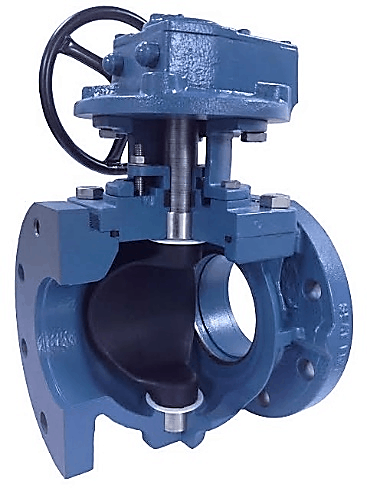
An eccentric plug valve is a quarter-turn rotary control valve in which the plug follows an eccentric rotational path during opening and closing.
Unlike concentric plug designs, the plug does not remain in continuous contact with the seat throughout its travel.
The defining characteristic of an eccentric plug valve is that the plug only contacts the seat near the fully closed position. During most of the operating stroke, the plug is offset from the seat, significantly reducing friction and mechanical wear.
Because of this operating principle, eccentric plug valves are sometimes described as rotary globe-type valves, combining features of rotary motion with globe-valve-style throttling performance.
Depending on design and size, eccentric plug valves are commonly supplied for medium to large diameters, with pressure classes ranging from Class 150 up to Class 1500. Their internal geometry allows stable performance in services where solid particles, slurries, or uneven flow profiles are present.
Compared with other plug valve designs, an eccentric plug valve represents a specialized solution within the broader product family described in our comprehensive plug valve manufacturer overview, where each valve type and its industrial applications are explained.
How Does An Eccentric Plug Valve Work?
Eccentric plug valves operate through a quarter-turn (90°) rotation of the valve shaft, driven manually or by an actuator.
As the shaft rotates, the plug moves along an eccentric path relative to the seat.
During opening:
The plug lifts away from the seat early in the rotation.
Once disengaged, the plug moves out of the main flow path, minimizing turbulence and erosion.
During closing:
The plug approaches the seat without sliding contact.
Final seating occurs only at the end of the stroke, where the plug is pressed firmly against the seat.
This operating sequence provides several engineering advantages:
Minimal friction during operation, reducing torque and extending service life.
Reduced seat and plug wear, especially in abrasive or slurry services.
Stable throttling characteristics, as the plug geometry allows controlled flow modulation.
Bubble-tight shut-off when properly specified with resilient or lined plug faces.
Installation Considerations
Correct installation is essential to achieve long service life and reliable performance from an eccentric plug valve.
The valve should be installed so that process flow enters from the seat side, ensuring that line pressure assists proper sealing and protects critical components from direct erosion.
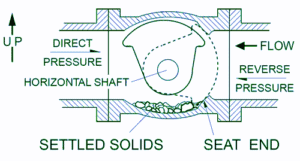
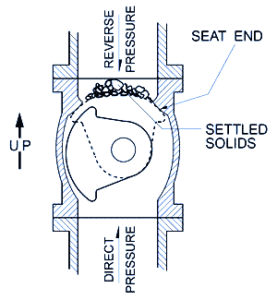
Eccentric plug valves can be installed in either horizontal or vertical pipelines, provided the following guidelines are observed:
Horizontal Installation
The operating shaft should be positioned horizontally.
In the open position, the plug should be located above the pipeline centerline.
This orientation reduces sediment accumulation and uneven wear.
Vertical Installation
The seat end should be positioned on the upper side of the valve body.
This configuration prevents solids from settling against the seat when the valve is closed.
These installation practices are particularly important in services involving slurry, wastewater, or abrasive media, where improper orientation can significantly shorten valve life.
Features And Engineering Benefits
Eccentric plug valves are commonly used for on/off and throttling service in demanding process conditions. Key design features and benefits include:
High flow capacity for a given valve size due to streamlined internal geometry.
Reliable shut-off performance maintained over extended operating cycles.
Quarter-turn operation enabling straightforward automation and fast response.
Reduced wear between plug and seat, extending maintenance intervals.
Suitability for abrasive and slurry services when equipped with elastomer-coated or lined plugs.
Erosion-resistant seat rings and retainers that can be serviced or replaced as needed.
Precisely machined shaft alignment ensuring smooth, repeatable operation.
Improved shaft and bearing design that enhances safety and reduces the risk of mechanical failure.
Fail-safe flow behavior that assists the plug toward a stable position in the event of actuator malfunction.
The throttling stability and wear characteristics of eccentric plug valves in abrasive and solids-handling service are widely recognized in industry practice, as discussed in technical publications by Valve World Asia.
From an engineering standpoint, these features make eccentric plug valves especially attractive where reliability, controllability, and long-term maintenance cost are critical considerations.
Typical Applications of Eccentric Plug Valves
In applications involving suspended solids, fibrous media, or abrasive particles, eccentric plug valves are commonly selected to maintain stable throttling and sealing performance. This is especially relevant in plug valve applications for wastewater and slurry service , where conventional rotary valves often experience rapid wear or unstable shut-off.
Thanks to their ability to handle suspended solids and maintain stable control, eccentric plug valves are widely applied in industries such as:
Mining and mineral processing
Oil and gas production and refining
Chemical and petrochemical processing
Power generation facilities
Pulp and paper production
Municipal sewage and sanitation systems
Wastewater treatment plants
Fertilizer and process industries
In these applications, eccentric plug valves are often selected where conventional ball or gate valves experience excessive wear, leakage, or unstable throttling behavior.
Summary
Eccentric plug valves provide a robust and economical solution for flow control in services involving abrasive media, suspended solids, or demanding throttling requirements.
Their eccentric operating principle minimizes wear, improves sealing reliability, and supports long-term performance in challenging industrial environments.
As an experienced NTGD plug valve manufacturer, we provide eccentric plug valve solutions designed to meet international standards and real-world industrial operating conditions. For detailed technical support, material selection guidance, or application-specific recommendations, please contact our engineering team.